
Derby Day Build & Race
Buy the parts, build the racer, then win the derby.


Projects that run over budget and over time
Sound familiar?
- “We start building before we agree on the plan.”
- “The same few people do all the work.”
- “Problems show up at the last minute, not the first.”
The Experience
Derby Day starts with a budget, not a kit. Each team becomes a small racing company with a starting fund of Derby Dollars, a garage space and a theme for its racer. You choose one theme for the whole event: pit lane cars, city rickshaws or Roman chariots.
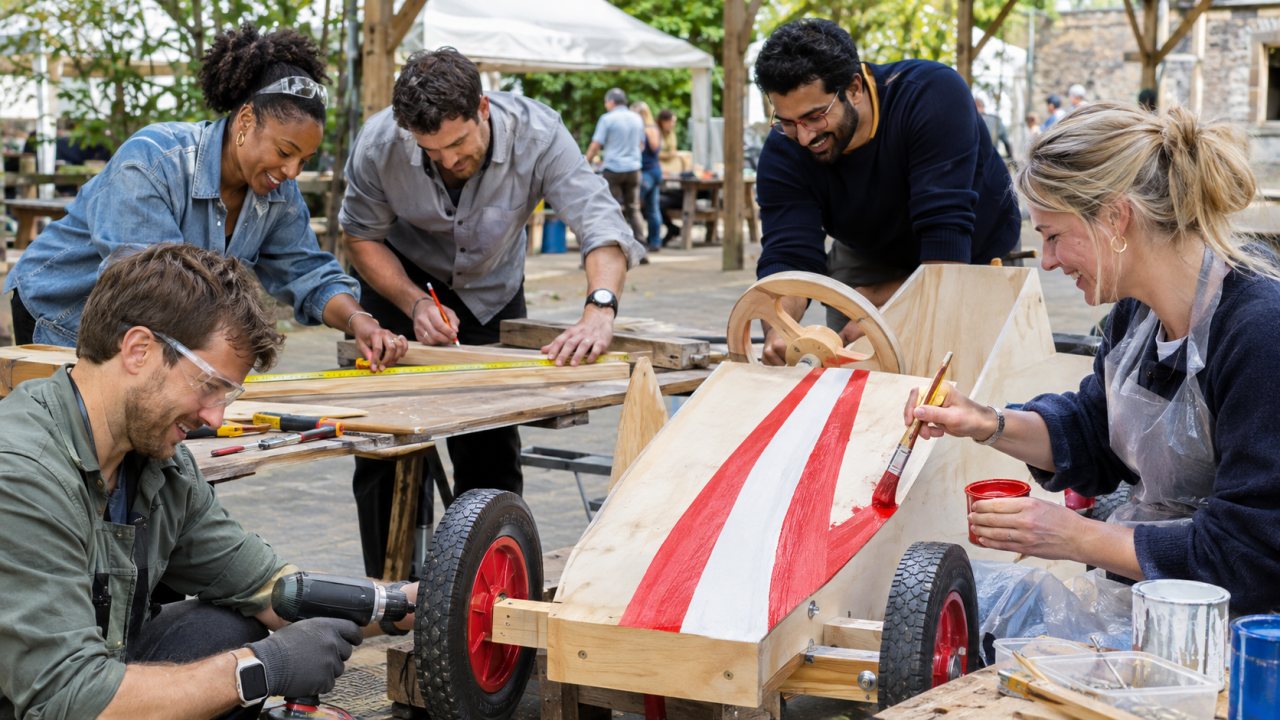
Every team starts with a pre-built, safety-tested chassis, then shops at the Parts Market for wheels, panels, tubes and decorations. Spend too much on speed and there is nothing left for style. Spend too little and the racer may fail scrutineering, the strength and safety check every vehicle must pass before it can race.
Race time is a relay derby. Every lap needs a new driver and new pushers, so the whole team takes part, not only the fastest runners. Points come from lap times, the design judges’ score and the money left in the bank, so the fastest team does not always win.
The program lasts about three hours and suits fifteen to two hundred guests. We run it in a ballroom, sports hall, car park or resort lawn, in North America, Europe and Southeast Asia.
The Takeaways
Every decision has a price. Teams have to plan before they buy, agree on what matters most and live with the trade-offs, just as they do with real budgets, deadlines and limited resources at work.
Building the racer needs clear roles. Some people design, some build, some manage money and some prepare the livery. Teams quickly see whether everyone knew their job, and how much time was lost when two people did the same task.
Scrutineering rewards teams that test early and fix problems before the big moment, not after it. Teams that skip testing often lose time at the worst moment, which makes a simple, memorable point about quality and preparation.
Because every lap needs a new driver and new pushers, the result depends on the whole team. In the debrief, teams discuss which spending decision made the biggest difference and how they made sure everyone played a real part. Derby Day also gives quieter people a stage. Teams leave with a fresh view of what each person brings to the table, on the track and at work.
Program flow
-
Garage briefing · 0–15 min
Each team becomes a racing company. The facilitator hands out Derby Dollars, garage spaces and the theme for the day, and explains the Parts Market, scrutineering and the relay derby rules. Teams agree on roles: designer, builder, finance lead and race captain.
-
Plan and buy · 15–50 min
Teams sketch their racer and plan their budget before the Parts Market opens. Prices for wheels, panels, tubes and decorations change during the session, so teams must decide when to buy, what to save and whether to trade parts with other teams.
-
Build and brand · 50–110 min
Teams assemble their racer on the pre-built chassis and give it a name, a livery and a team story. Facilitators help with techniques, but the design decisions are the team's own. Teams that test early spot weak points while there is still time to fix them.
-
Scrutineering · 110–130 min
A panel of judges checks every racer for strength and safety: can it carry its driver, steer straight and survive a test push? Teams that fail can repair and return, but repairs cost time and money.
-
Relay derby · 130–165 min
Racers line up for a relay derby. Every lap needs a new driver and new pushers, so the whole team takes part. The crowd cheers, the timing board updates live and the design judges score each racer as it passes.
-
Podium and debrief · 165–180 min
Points for speed, design and money saved decide the podium. The facilitator leads a short debrief on planning, budgets and roles, and each team names the spending decision that made the biggest difference.
The game ends. The learning starts.
Every Phoenix program closes with a guided debrief. These are the questions for Derby Day Build & Race:
- Which spending decision made the biggest difference?
- When did we plan, and when did we just start building?
- Did everyone have a clear role, and did it change?
- What did scrutineering teach us about testing early?
- Which habit from today will we use in our next project?
What we bring, what you provide
We bring
- Pre-built racer chassis, parts and tools
- Derby Dollars and the Parts Market
- Facilitators, race marshals and judges
- Race track set-up and live timing
- Driver helmets, podium and prizes
- A short guided debrief
You provide
- A ballroom, hall, car park or lawn with a smooth surface
- Space for team garages around the track
- Screen and sound for the timing board, if indoors
- Catering and refreshments
- Transport to and from the venue
Frequently asked questions
Do we need building skills?
No. Facilitators show teams how the parts fit together, and the challenge is in the planning and teamwork.
Is the race safe?
Yes. Every racer is built on our load-tested chassis and pushed at walking pace on a marked track. Drivers wear helmets, and every racer must pass scrutineering before it races.
Can it run indoors?
Yes. A ballroom or sports hall works well, as does an outdoor space with a smooth surface.
How big is each team?
Usually six to ten people, so everyone has a role in the build and the race.
Can we choose the theme?
Yes. Choose pit lane cars, city rickshaws or Roman chariots, or ask us for a theme that fits your event.
What happens to the racers afterwards?
We dismantle and reuse materials wherever possible, and teams can keep their name boards as souvenirs.

The Real Brief
A real charity. A real need. Your team builds the answer.
Load Test Bridge
Design it on a budget. Then see how much it holds.
 Hoi An
 Lantern Makers
Craft silk lanterns with local artisans, then light them up together.
Request a quote for Derby Day Build & Race
Tell us your group size, date and goals. We will reply with a tailored proposal.