
Chain Reaction
Your part must trigger the next.
Teams that depend on each other clash
Sound familiar?
- “Handovers between departments drop the ball.”
- “People optimise their part and ignore the next team.”
- “Nobody talks until something has already broken.”
The Experience
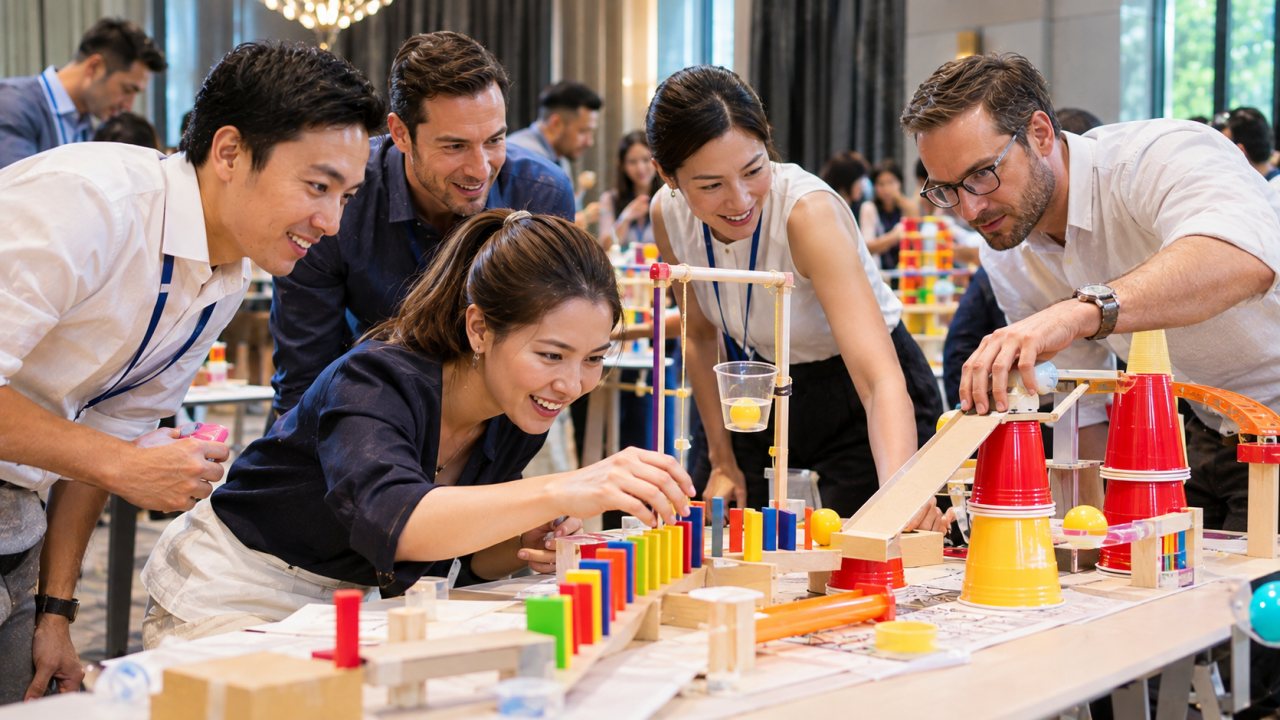
Chain Reaction gives every team one section of a giant machine and one rule: your part must trigger the next. From a kit of ramps, levers, balls and dominoes, teams build a stretch that takes an incoming signal and passes it on, cleanly, every single time.
The catch is the handover. Each section must connect precisely to its neighbours, so teams spend as much time talking across borders as building their own piece. A part that works alone but fails to pass the signal on is worse than useless to the room.
The finale is one long attempt: a single marble sets off section after section down the whole room. If every handover holds, the machine completes in one unbroken chain to a huge cheer. If one fails, teams gather to fix it together and try again.
It runs for about two hours indoors, for twenty to one hundred and fifty people in teams of five to six. We run it at your venue or ours, with pre-made parts so every section is built within the time.
The Takeaways
Chain Reaction makes handovers the whole game. A section that works in isolation but fails to pass the signal on teaches the lesson instantly: local success means nothing if the connection breaks. It is the clearest possible picture of why silos quietly cost organisations so much.
Because the machine only works if every team talks to its neighbours, communication across borders stops being optional. Teams learn to agree interfaces early, test the handover often and warn others before changing anything — exactly the habits that keep dependent teams from tripping over each other at work.
The single final attempt turns competitors into one team. Every section depends on all the others, so a failure anywhere brings people together to diagnose and fix it, and the shared cheer when it finally runs is a genuine moment of collective achievement.
In the debrief we link the build to work: where handovers held or broke, how teams communicated across borders and how they fixed problems together. Each group notes two or three takeaways, and HR receives a short written summary within three working days.
Program flow
-
Welcome & the rule · 0–15 min
Teams take their place in a long line of sections and learn the one rule: your part must reliably trigger the next. Facilitators show the kit, the handover points and how the full run will work before building starts.
-
Build your section · 15–65 min
Teams build their stretch of the machine from pre-made parts, making it do something fun along the way. The real work is at the edges, where they must agree exactly how the signal will arrive and leave with the teams on either side.
-
Test the handovers · 65–90 min
Sections are joined and tested in pairs, then in longer runs. Handovers that fail send teams back to adjust and renegotiate with their neighbours, so communication across borders becomes constant and concrete.
-
The full run · 90–110 min
The whole room attempts one unbroken chain from end to end. A break anywhere stops everything, so teams rush to the failure together, fix it and reset, until the single marble completes the journey to a shared cheer.
-
Debrief & HR summary · 110–120 min
A guided debrief links the build to work: handovers, cross-border communication and fixing problems together. Each team notes two or three takeaways for the HR summary sent within three working days.
The game ends. The learning starts.
Every Phoenix program closes with a guided debrief. These are the questions for Chain Reaction:
- Where did a handover break, and what fixed it?
- How early did you talk to your neighbours about the connection?
- What happened to the room when one section failed?
- How did it feel when the full chain finally ran?
- Where do handovers let your real teams down, and what will you change?
What we bring, what you provide
We bring
- A build kit of ramps, levers and parts for every section
- The full machine layout and the GoQuest app for milestones
- A lead facilitator plus build support (one per fifty guests)
- The joined test runs and the final full-room attempt
- A guided debrief and a written HR summary within three working days
You provide
- A room or hall long enough for the full machine
- Tables or clear floor space for each section
- Power and reliable lighting for the build
- Any catering or refreshments around the session
- Phones for teams to use, or tell us if you need ours
Frequently asked questions
How many people can take part?
From twenty up to one hundred and fifty, in teams of five to six. More teams simply make a longer, more spectacular machine.
How long does it take?
About two hours, including the brief, build, handover testing, the full run and a short debrief. We can adjust it to your day.
Do people need to be technical?
No. The parts are simple and pre-made, so anyone can build. The challenge is in the communication and handovers, not in engineering skill.
What if the chain keeps failing?
That is part of the fun. Teams fix failures together and reset, and facilitators help, so the room almost always lands a full run before the end.
Can it be customised for us?
Yes. We can theme the sections and the final trigger around your brand or message. Custom theming needs about two to three weeks.
Where can it run?
Any indoor venue with a long enough space for the machine — a hall, large meeting room, your office or ours.
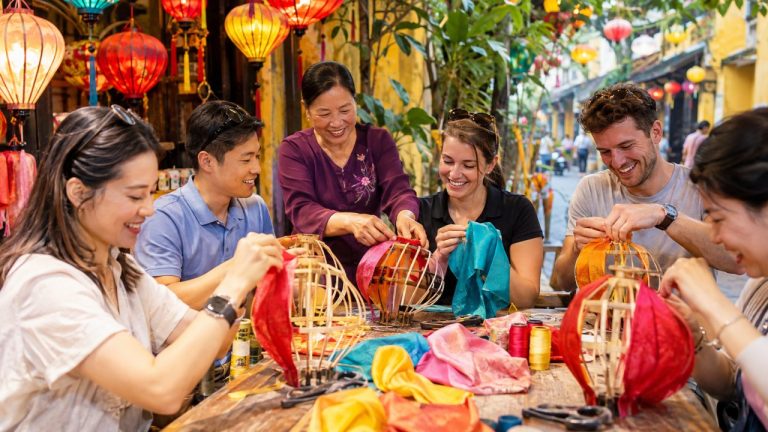 Hoi An
 Lantern Makers
Craft silk lanterns with local artisans, then light them up together.

The Real Brief
A real charity. A real need. Your team builds the answer.
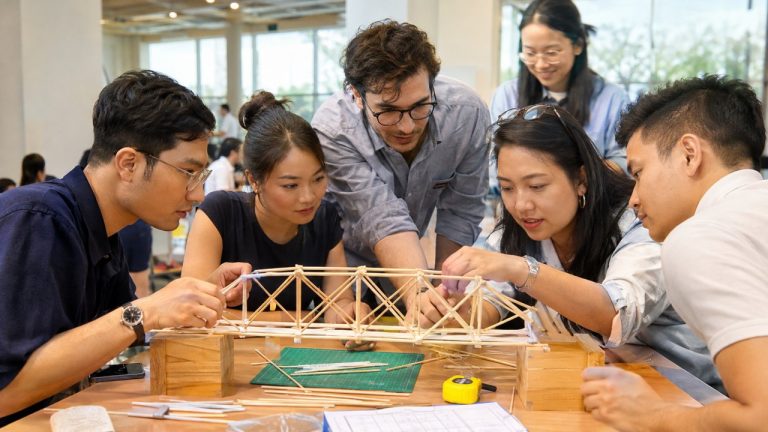
Load Test Bridge
Design it on a budget. Then see how much it holds.
Request a quote for Chain Reaction
Tell us your group size, date and goals. We will reply with a tailored proposal.